Ingestion
Turning an uploaded file into searchable passages takes minutes, can fail halfway, and must never run twice. The design is shaped almost entirely by those three facts.
Messages carry a job id and nothing else
Everything a worker needs arrives when it claims the job. A message that sat in a queue while the document was replaced therefore cannot act on a stale copy of what it was published with.
Stages, entry states, and leases
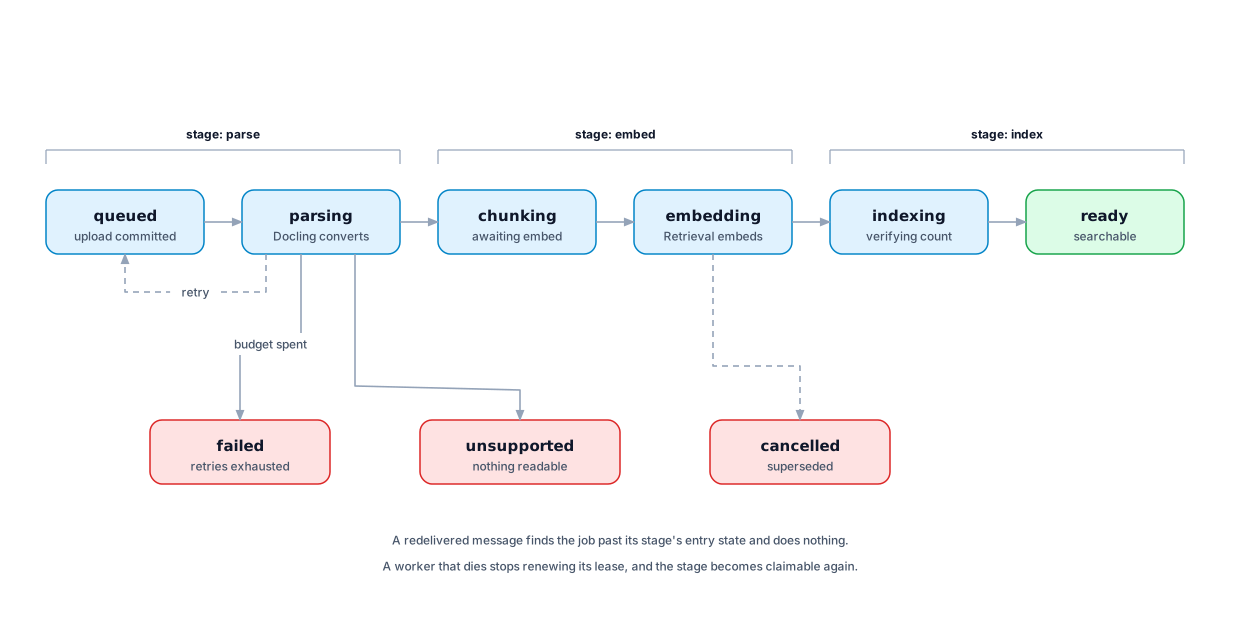
Each stage names three states: the one it must be claimed from, the one its holder sets while working, and the one completion advances to — which is the next stage's entry state. A redelivered message finds the job past its stage's entry state and is told the stage is already done.
A claim is held by a lease, not by the state alone. State alone cannot exclude a second worker: one that crashed mid-stage leaves the job marked active, and a rule that refused to re-enter an active stage would strand it forever. The lease expires instead, and the stage becomes claimable again with no operator involved.
Every transition is a single conditional update. Read-then-write would let two workers both observe a claimable job and both proceed.
Publishing happens after the commit
An upload is committed before its message is published. A message sent first could outlive a rolled-back upload, leaving a worker to claim a job that does not exist.
The opposite failure is possible and is the one worth having: a crash between committing and publishing leaves a job queued with no message. That is visible, re-enqueueable, and harms nothing meanwhile.
Retries
A worker reports whether a failure was transient, because it is the only party that knows. Transient failures release the lease and return the job to its stage's entry state; a document Primer cannot read fails terminally without consuming the retry budget.
Control holds the hard attempt bound rather than trusting a worker's own counter, which a broker redelivery resets. Backoff is jittered, so a broker outage does not return as a synchronised herd of retries.
Messages the broker gives up on go to a dead-letter queue, where an operator can find them. Dropping them would leave a document stuck with nothing to explain why.
Parsing
Conversion and chunking are Docling. Primer adds no parser and no splitter of its own.
Conversion is the first code to touch bytes a stranger uploaded, so it runs against a private, read-only copy in a directory that is removed on every path out.
Its time budget is checked between phases rather than by interrupting the converter: that work happens inside native extensions, where killing a thread risks a corrupt process. The hard stop is the worker's task time limit, which kills the process and lets the job's lease expire.
Chunking is sized against the embedding model
A chunk is both what gets embedded and what gets quoted back in a citation,
so its size is a retrieval decision and a legibility one at the same time.
Docling's HybridChunker bounds chunks by tokens and merges the small
pieces that a document's structure leaves behind, and to do either it needs
the tokenizer of the model that will embed them. PRIMER_CHUNK_TOKENIZER
names it - normally the embedding model's own Hugging Face id, which the
Helm chart derives from inference.embeddings.model when that names a
repository.
Without a tokenizer, chunking falls back to document structure alone. That is not a milder version of the same thing. Structure alone emits one chunk per text item and merges none of them, so a document whose layout is a long list of short items - a form, a statement, most scanned PDFs - is stored one line at a time. Those fragments embed to nothing meaningful, they retrieve badly, and the citation under an answer quotes a couple of words. Measured on a W2-shaped document: 20 chunks averaging 13 characters, against a single 274-character passage once peers are merged.
The fallback exists for the cases that genuinely have no tokenizer to fetch - a test that must not reach the network, a hosted embedding model that publishes none - and the worker warns on startup whenever it is in that state, because the symptom points nowhere near the cause.
A tokenizer that is configured but cannot be loaded fails the worker at startup rather than falling back, since falling back would answer a misconfiguration by silently doing the thing the setting exists to prevent.
Chunk size is changed by reindexing, never in place: chunks are decided at parse time, so existing documents keep the passages they were split into until they are parsed again.
Deletion, and shared bytes
Deleting tombstones the document first. That is the deletion the user asked for and it takes effect at once; everything after is cleanup, scheduled separately so a slow or failing cleanup never leaves a deleted document answering questions.
Cleanup then removes passages, then metadata, then the stored bytes — bytes last, and only for content nothing references any more.
Which sources are free is decided by PostgreSQL rather than by counting. The
foreign key from versions to sources is RESTRICT, so deleting bytes that
another library still points at simply fails, and that failure is the
answer. It cannot race with an upload either, because the version insert
holds a lock the delete waits on. A count would have to guess about
transactions it cannot see.
The remaining gap is a worker that dies between the database freeing an object and the bytes being removed. That leaks storage rather than losing data, and is recoverable by a sweep that does not exist yet.
Chunks carry their scope
Every passage carries its library, document, version, owner, and generation. Retrieval authorizes by filtering on those fields, and a filter cannot consult a database.
Chunk ids are derived from the version, the generation, and the position, so re-running a stage rewrites the same rows rather than doubling the index.
Each passage keeps two texts: the document's own words, which is what a citation quotes, and a version with its section heading prepended, which is what gets embedded. A heading helps a passage keep the subject it is about; putting it in the citation would quote words the document does not contain.